Someone recently asked me when I started playing D&D. When I told them it was the mid-80s, their eyes lit up. “Wow! The 80s. You had the Stranger Things experience.”
I stopped reflecting on it, and I realized: Yes. Yes, I did.
We didn’t have the Demogorgon (well, not in real life), and we didn’t have the basements. But we had the dinner table, the dice, and the absolute mystery of this game that seemed to exist in the shadows.
The Artifacts of Legend
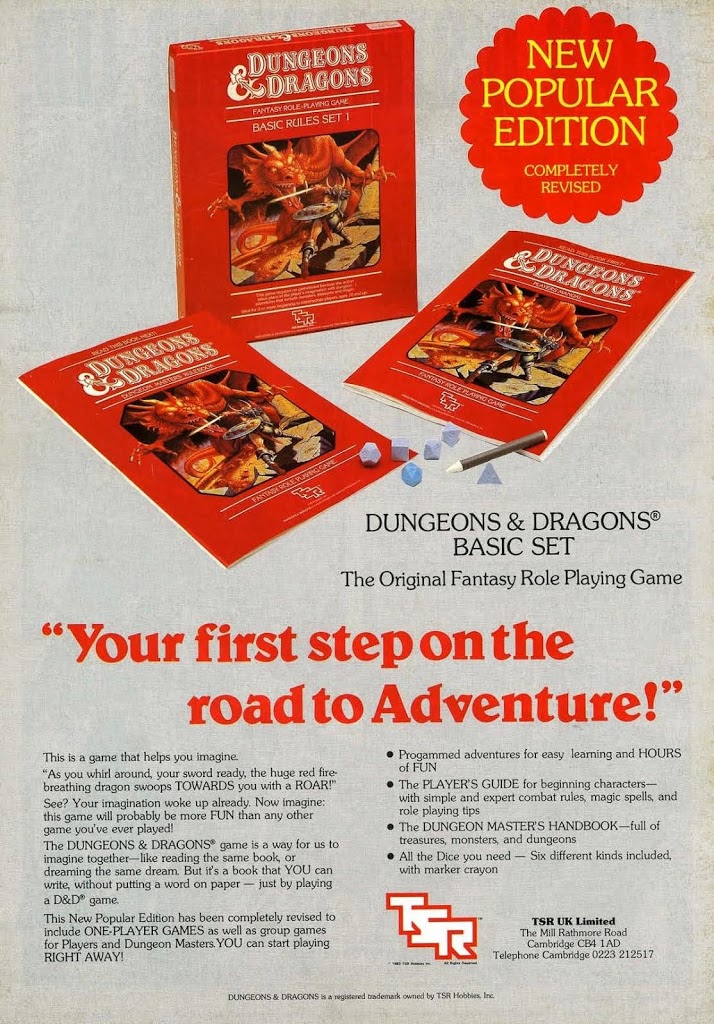
I was aware of Dungeons & Dragons long before I rolled a d20. As I mentioned in my “Proto-Years” post, the game was already seeping into my life through the LJN action figures and those iconic ads in the back of comic books. I would see the books and boxed sets sitting on the shelves at The Book Store in Old San Juan or at B. Dalton in the mall—forbidden tomes promising adventure.
My curiosity finally won out in 1985. I bought the Frank Mentzer Dungeons & Dragons Basic Set—the legendary Red Box.
I opened it up and devoured the solo adventure immediately. That part made perfect sense to me; it was just like the Choose Your Own Adventure or the Be an Interplanetary Spy books I loved, but with dice!
But then I turned the page to the rest of the book. The rules. The text. The procedures.
It made no sense.
You have to remember, this was a time before the internet. There were no “actual play” video series, no YouTube tutorials, no Reddit threads to ask for clarification. I didn’t know anyone who played D&D properly.
I did have a classmate who I used to see walking around the schoolyard with a group of friends. He would carry a notebook, reading from it while the others jumped over imaginary obstacles or walked along a line on the pavement. When I asked him what they were doing, he said, “Playing Dungeons & Dragons.”
I didn’t quite know how you played D&D, but looking at them, I thought: That doesn’t seem right.
I learned later that his older siblings played the game but wouldn’t let him join. So, he had done some espionage, taking notes from their books when they weren’t looking, interpreting what he could from overhearing their sessions, and making up his own rules based on the fragments he understood.
I had to find out the truth. I had to know how you really played. But after that initial attempt with the Red Box, I hit a wall. I didn’t understand the rules, and I didn’t have a party. So, the red box languished on my bookshelf, unused.
The Challenge Accepted
Fast forward to the summer of 1986.
A neighbor, one or two years my senior, came back from a friend’s house buzzing with energy. He had played D&D. He was fascinated by it. He wouldn’t stop talking about the adventure.
I blurted out, “I have that game! We should play it.”
“We definitely should,” he said.
I looked at him, relieved. “Since you’ve played it, you should run it for us.”
He hesitated. He admitted he wasn’t sure how to do that part. He looked at me and suggested that since I was the one who owned the box, I should be the Dungeon Master.
Never one to shy away from a challenge, I grinned. “Sure, let’s play tomorrow!”
The Long Night
I went back home, pulled the Red Box off the shelf, and started reading.
Panic set in immediately.
It made even less sense than before. I realized, with dawning horror, that I had to read the whole thing, learn to play the game, and run the game… by tomorrow morning.
I should have canceled. I should have asked for a few more days. But I didn’t.
I stayed up late, poring over the text, trying to decipher to-hit rolls and saving throws. Late into the night, I developed a splitting headache. I took some painkillers, rubbed my temples, and went to bed with my brain buzzing. I had learned as much as I could. I just hoped it was enough.
As an aside, looking back now, the Mentzer Red Box was a masterpiece of instructional design. It was steeped in the style of the day—callers, mappers, strict procedures—but it did a wonderful job of teaching that specific style of play. I ran my first session without ever seeing the game played, taught only by the words on the page.
The First Roll
The next day, we met at my house.
There were seven of us—neighbors and childhood friends—sitting around a table. We used my collection of LJN toys to keep track of the marching order. I opened the book, and we wandered into our first dungeon.
That was my first time Dungeon Mastering. It was chaos, it was messy, and it was magic.
The rest, as they say, is history.

Historical anecdote aside, I really liked the writing here! Felt very invested in the story as it went along! Feeling the tension. Well done!
Some parallels to my early experiences. Though I did not start this young.